Choosing the right Inflatable Air Blower is not simply a matter of buying the highest-rated motor. Air volume, static pressure, noise, duty cycle, power supply, and fabric resistance must work together. A blower that sounds powerful may still fail to keep an inflatable structure firm.
Industry data supports careful selection. Grand View Research’s Industrial Air Blower Market analysis identifies construction, manufacturing, ventilation, and temporary structures as important demand areas. Its findings also highlight efficiency and dependable operation as continuing purchasing priorities. Meanwhile, ASTM F2374 and U.S. Consumer Product Safety Commission guidance stress proper anchoring, airflow management, inspection, and safe operating conditions for inflatable amusement devices. These details matter beside a real installation, where a loose seam, long duct, or wet extension lead can change performance quickly.
Ventilation researcher Dr. Steven J. Hoff offers a useful principle: “The right blower is not always the biggest blower.” That idea deserves attention. Oversizing may increase noise, energy use, and fabric stress without improving stability. Undersizing creates sagging surfaces and unstable shapes. Sometimes, buyers focus too heavily on horsepower. That is an easy mistake.
A reliable decision begins with the manufacturer’s required airflow and pressure range. Check the inlet diameter, continuous-duty rating, thermal protection, and replacement-parts availability. Compare measured performance, not only marketing claims. No checklist is perfect. Still, a careful match usually outperforms a louder, larger, and poorly suited Inflatable Air Blower.
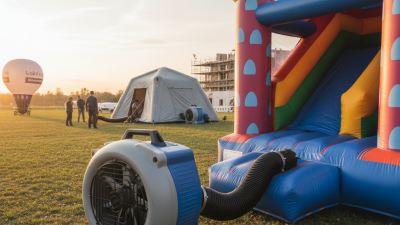
Understanding blower types makes inflatable equipment safer and more reliable. Centrifugal blowers move large air volumes at modest pressure. They suit bounce houses, advertising arches, and event tunnels with steady air leakage. Axial blowers produce strong airflow with low resistance. They work well for ventilation, cooling, and lightly sealed inflatables. Regenerative blowers provide more stable pressure for sealed structures and longer operating periods.
Application conditions should guide the choice. Check the inflatable’s required airflow, working pressure, inlet size, and expected leakage. A blower that seems powerful may still perform poorly if its pressure cannot overcome fabric resistance. Measure the distance between the blower and the inflatable. Long or narrow ducts can reduce airflow noticeably.
Noise also matters near schools, exhibitions, or residential areas. Small details become important.
Duty cycle deserves careful attention. Intermittent use may allow a compact blower, while continuous operation needs durable bearings and effective cooling. Keep the blower away from rain, loose fabric, and blocked vents. Use a suitable pressure-relief method when recommended by the equipment designer. Field testing often reveals a mistake: selecting by motor power alone. I have found that airflow, pressure, and leakage must be considered together. No single rating tells the whole story. Recheck performance after installation, because seams, zippers, and temperature can change the final result.
Matching airflow and pressure to your inflatable structure prevents weak inflation and unnecessary stress. Airflow, measured in CFM or m³/h, controls how quickly the structure fills and replaces escaping air. Pressure, measured in pascals, determines whether it stays firm against wind, seams, and normal movement. An open inflatable tunnel usually needs strong airflow with modest pressure. A sealed advertising balloon may require less continuous airflow but greater pressure stability. Check the structure’s specifications before selecting a blower.
Tips: Measure the duct length and count every bend. Long ducts reduce real airflow. Compare the blower’s output at the required pressure, not its free-air rating. Test the structure with a pressure gauge when possible. It should feel firm, not drum-tight.
In practical setup work, airflow figures can look impressive on paper. They may change after adding filters, reducers, or extension cables. A small mismatch can leave corners soft. Excess pressure can also strain stitching, zippers, and anchor points. Choose a blower with adjustable control or a suitable pressure regulator. Do not assume the largest unit is safest. I once underestimated leakage around a poorly fitted opening, and the blower ran continuously. The better approach is to inspect seams, measure operating pressure, and allow a modest performance margin. Weather changes too. Wind and cold air may alter performance, so real-world testing remains essential.
How to Choose the Right Inflatable Air Blower?
Selecting the correct blower starts with airflow and pressure, not motor size. Measure the inflatable’s volume, seams, access points, and expected operating height. Then estimate the airflow needed to replace leakage continuously. A blower rated only by free-air CFM can mislead. Check its performance at the required static pressure.
The U.S. Department of Energy’s Improving Fan System Performance sourcebook reports that fans can consume about 15% of electricity in U.S. manufacturing. That figure shows why efficiency deserves attention, even for temporary inflatables. Select a motor that reaches operating pressure without running at full load. Oversizing often creates noise, heat, and unnecessary energy use. It is an easy mistake.
Power supply matters too. Confirm voltage, frequency, outlet capacity, and cable length before installation. Battery systems offer mobility, but their runtime drops under continuous high load. Inverter losses also reduce usable energy. For fixed installations, direct mains power is usually more practical. For remote sites, calculate watt-hours carefully instead of trusting advertised runtime.
Efficiency is not just the motor’s label. It includes airflow delivery, pressure loss, controls, and leakage. The International Energy Agency estimates motor-driven systems use roughly 46% of global electricity. That broader data supports careful blower selection. Use airflow and pressure measurements based on AMCA 210 or ISO 5801 methods when possible. Field conditions remain imperfect. A small pressure gauge and a real runtime test can reveal more than a catalogue number.
Typical blower selection ranges by inflatable size, airflow, static pressure, and motor input power
Smaller inflatables generally need about 80–180 m³/h of airflow, while large commercial inflatables may require 350–700 m³/h. Higher static pressure helps maintain inflation when fabric seams, valves, and airflow restrictions create resistance. Choose a blower with enough airflow for the required inflation time, then confirm that its pressure rating matches the inflatable design. The values shown are representative engineering ranges; always verify the equipment specifications and site power supply before purchase.
Choosing an inflatable air blower starts with safety, not airflow alone. Look for grounded plugs, thermal overload protection, guarded intake grilles, and stable housing. IEC 60335-2-80 addresses safety requirements for household and similar electric fans, offering a useful reference for motor protection. The IEC 60529 IP Code also provides clear weather-resistance data. IPX4 protects against splashing water, while IPX5 handles water jets. Neither rating permits flooding or outdoor storage in rain.
Durability depends on more than thick plastic. Check the motor’s duty rating, sealed bearings, reinforced cable entry, and continuous operating temperature. A blower may feel powerful during a five-minute test, then overheat after hours beside a warm pavement. I have seen users focus on air volume and ignore ventilation space. That was a poor judgment. Leave clear airflow around the intake, inspect seams and cords before every use, and stop operation when wind, rain, or unusual vibration appears. Weather changes faster than many setup plans.
Tips: Compare the blower’s airflow rating with the inflatable’s required pressure, not just its wattage. Choose an IP-rated enclosure for the expected exposure, but add a raised, covered position. Review inspection guidance from ASTM F2374 and EN 14960-1 when the blower supports inflatable play equipment. Keep a simple log for cleaning, overheating, damaged guards, and replacement dates. Small records often reveal repeated faults before they become serious.
Comparing Installation, Maintenance, Noise, and Operating Costs
Choosing an inflatable air blower starts with the installation site, not the product label. Measure the required airflow and pressure before comparing prices. An undersized blower may run continuously and still leave the inflatable soft. An oversized unit can waste electricity and stress seams. Check the power supply, cable length, ventilation, and connection diameter. A short, straight duct usually improves performance. I once underestimated the effect of a narrow connector. The blower worked, but the motor became noticeably hotter.
Maintenance affects reliability more than many buyers expect. Clean intake filters regularly, especially near grass, dust, or fabric storage areas. Inspect hoses, clamps, seals, and electrical connections during each setup. Listen for new vibration or rattling. These signs can reveal bearing wear before a breakdown occurs. Keep a simple service record. It makes recurring problems easier to identify, although records are often neglected during busy event preparation.
Noise deserves practical testing. A blower placed beside guests can create constant background disturbance, even when its decibel rating seems acceptable. Use a ventilated enclosure only if airflow remains unrestricted. Rubber pads can reduce vibration through floors and platforms. Operating cost includes electricity, maintenance, replacement parts, and downtime. Compare wattage with expected daily running hours, not just purchase price. Variable-speed control may reduce energy use when full airflow is unnecessary. However, savings depend on correct settings and actual usage. A cheaper model can become expensive when it needs frequent repairs or consumes more power. Test the complete setup under normal conditions before committing to a long-term installation.