




Why Regenerative Blowers Are Quietly Becoming the Workhorse of Modern Industry
Walk through a food processing line in Germany, a pharmaceutical clean room in South Korea, or a plastic extrusion plant in Mexico right now, and there's a good chance you'll find a Regenerative Blower humming somewhere in the background. Not the loudest piece of equipment on the floor. Not the most glamorous. But increasingly, the one engineers reach for first when they need clean, reliable, oil-free airflow without the complexity of a large compressor system.
The global regenerative blower market was valued at approximately USD 950 million in 2025 and is on track to reach over USD 1 billion by 2026, with analysts projecting growth to USD 1.53 billion by 2036 at a CAGR of 3.8%. In the industrial segment, growth rates of 8.2% annually have been reported, driven by adoption in sectors that never used to consider this technology a first choice.
Food and Beverage: The Unexpected Growth Driver
Food processing has emerged as one of the fastest-growing end markets for regenerative blowers. Unlike oil-lubricated rotary blowers, regenerative blowers move air through a non-contact impeller — no lubricants in the airstream, no seals to wear and contaminate product lines, and no scheduled oil changes. For facilities producing packaged foods, beverages, or pharmaceutical products where contamination is a zero-tolerance issue, that oil-free guarantee is the deciding factor.
Applications include:
- Pneumatic conveying of flour, sugar, starch, spice powders, and granules through closed-pipe systems
- Vacuum lifting and transfer of packaged goods on production lines
- Drying and cooling of freshly extruded pasta, chips, and snack products
- Aeration in fermentation and biogas systems
- Sparging and mixing in beverage tanks and dairy processing
What Makes the Regenerative Principle Different
Air enters a side-channel housing and is caught by the rotating impeller blades. As the impeller spins, it accelerates the air and throws it outward by centrifugal force. The air then re-enters the blade path and gets accelerated again — cycling repeatedly around the ring channel before exiting at the outlet port. This regenerative action means pressure builds progressively with each pass rather than in a single compression stage.
Key performance characteristics:
| Parameter | Typical Range |
| Operating pressure | 10 – 40 kPa |
| Flow rate | 20 – 2,000 m³/h |
| Noise level | 55 – 75 dB(A) |
| Drive type | Direct-drive, no belt or coupling |
| Lubrication | None (oil-free) |
| IP rating | IP54 standard, IP65 available |
The absence of gears, oil, or contact seals dramatically reduces maintenance. Most units only require periodic filter cleaning and bearing replacement every 20,000–40,000 operating hours.
Wastewater and Aquaculture: The Original Application — Still Growing
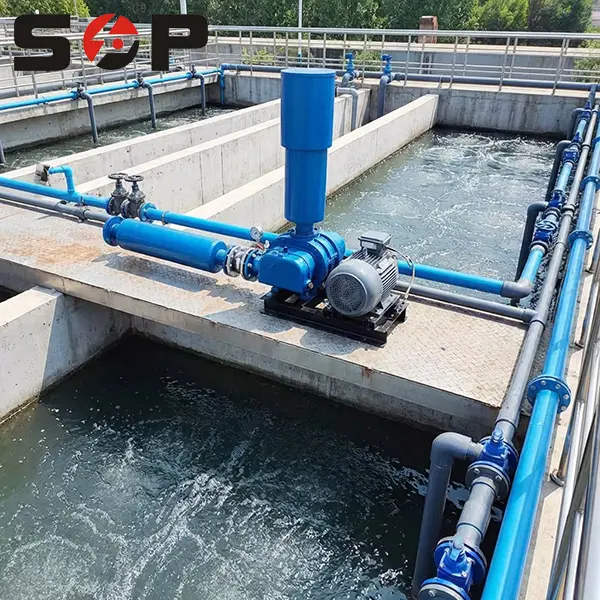
Wastewater treatment and aquaculture remain the largest installed base globally. Fine bubble aeration systems for biological treatment tanks, sludge digestion aeration, and fish pond oxygenation continue to drive unit volumes across Asia, Latin America, and the Middle East. Smaller wastewater treatment plants — serving towns, industrial parks, and commercial developments — particularly drive growth in the sub-10 kW segment.

What to Watch in 2026 and Beyond
Three trends are reshaping how regenerative blowers are specified and purchased:
1. Energy Efficiency Requirements Tightening
IE3 and IE4 motor standards are now mandatory in the EU, and increasingly expected in other export markets. Buyers are asking for motor efficiency data up front, and manufacturers who can't provide it are being filtered out of tenders early.
2. Integration with Variable Frequency Drives (VFDs)
More buyers are requesting inverter-compatible models that can modulate airflow based on process demand rather than running at fixed speed. This reduces energy consumption by 20–40% in applications with variable load, such as aquaculture ponds where oxygen demand changes with temperature and stocking density.
3. Demand from Southeast Asia and the Middle East
Infrastructure investment in Vietnam, Indonesia, the Philippines, and the Gulf states is generating substantial new demand across water treatment, food processing, and light manufacturing. Local distributors report inquiry volumes up significantly compared to two years ago.
Final Thought
Regenerative blowers don't make headlines. But they are one of the most broadly applicable air-moving technologies available — reliable, clean, quiet, and increasingly affordable as manufacturing volumes grow. For buyers evaluating their options, the question is rarely whether a regenerative blower can do the job. It's whether the pressure and flow requirements fall within the technology's range. If they do, it's almost always the lowest total-cost-of-ownership choice.
Interested in finding the right model for your application? Visit https://www.sopblowers.com/contact-us/ for a free selection consultation. We've helped 5,000+ customers across 150 countries find the right blower.